Thermal management is in the spotlight among many new product designs due to the growing popularity of electrification. Today, people want their devices to be smaller and thinner, while also being faster, more efficient, and powerful. With less room but a greater need, the challenge for engineers is to find the right set of tools to support their thermal management needs.
Heat generation is the major cause of electronic failures, which has negative consequences for overall product performance.
Major Causes of Electronic Failure
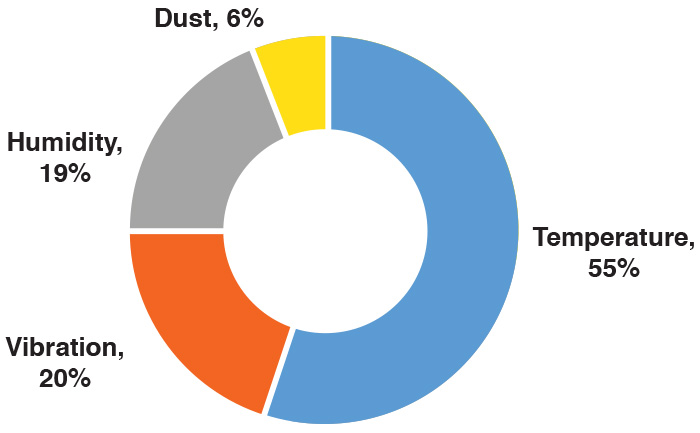
Source: BBC Research Wellesley, MA
Consequences of Heat
- Product life
- Reliability
- Efficiency
- Operating speed
Zatkoff Seals & Packings has unique solutions for all major causes of electronic failure; however, the focus of this article is how temperature affects applications and what thermal interface materials or TIM can be used to prevent product failure.
Objective of Thermal Management
The objective of TIMs is to provide an efficient thermal path from the package surface to the initial heat dissipater and into the ambient environment using conduction and then consequently convection and radiation.
The typical thermal path can be divided into three distinct stages that represent a series of resistance to the flow of heat:
- IC junction to device case: Rj-c
- Device case to heat sink: Rc-s
- Heat sink to ambient air: Rs-a
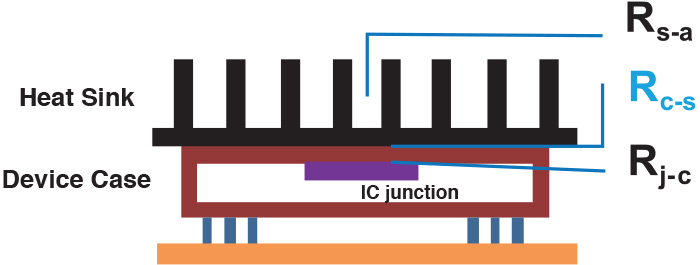
Resistance from IC Junction to Air:
Rj-a = Rj-c + Rc-s + Rs-a
Zatkoff provides solutions here^
Irregularities at contact between each of the surfaces in the illustration above allow air entrapment which reduces the thermal conductivity of the system and may cause the application to overheat.
Thermal conductivity (k) - Perspective
| Materials + air |
Thermal
Conductivity W/m-K |
| Copper |
398.0 |
| Gold |
296.0 |
| Aluminum |
205.0 |
| Air (@20C) |
0.0257 |
Thermal
Interface
Materials |
Thermal
Conductivity
W/m-K |
Typical
|
| Polymers |
0.1 – 0.2 |
| Thermal greases |
0.5 – 4.0 |
Phase change
(PCM) |
0.6 – 3.0 |
| Gap fillers |
0.5 – 6.0 |
| Tapes |
0.3 – 1.5 |
Thermal Interface Materials (TIMs)
Parker Chomerics’ thermal interface materials are critical for the heat transfer from semiconductor package surface of junction to a heat dissipater, such as heat sinks and heat spreaders. Click on the link below to find out about our unique thermal management solutions.
Zatkoff Thermal Line Card
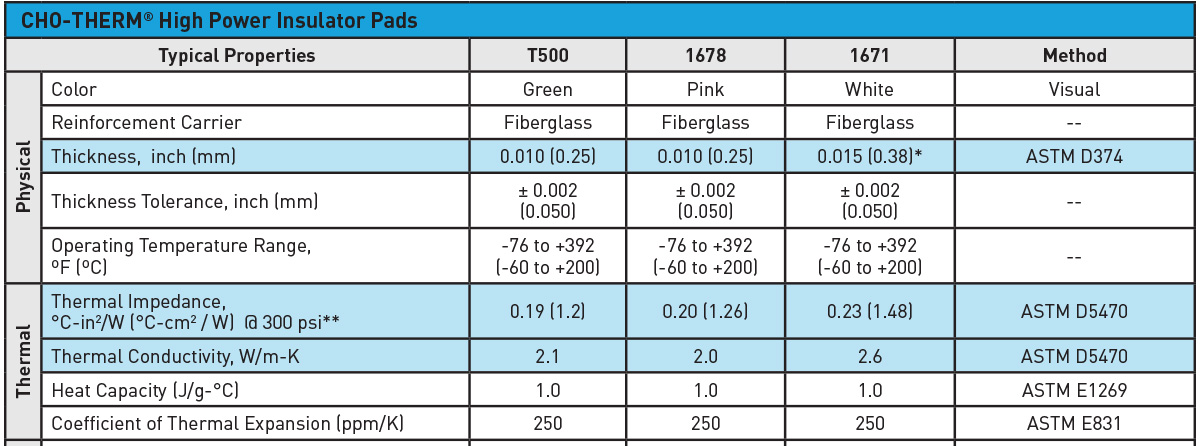
Key Properties for Parker Chomerics TIMs
- High Thermal Conductivity k
- Low Thermal Impedance θ
θ = Rcontact 1 + R + Rcontact 2
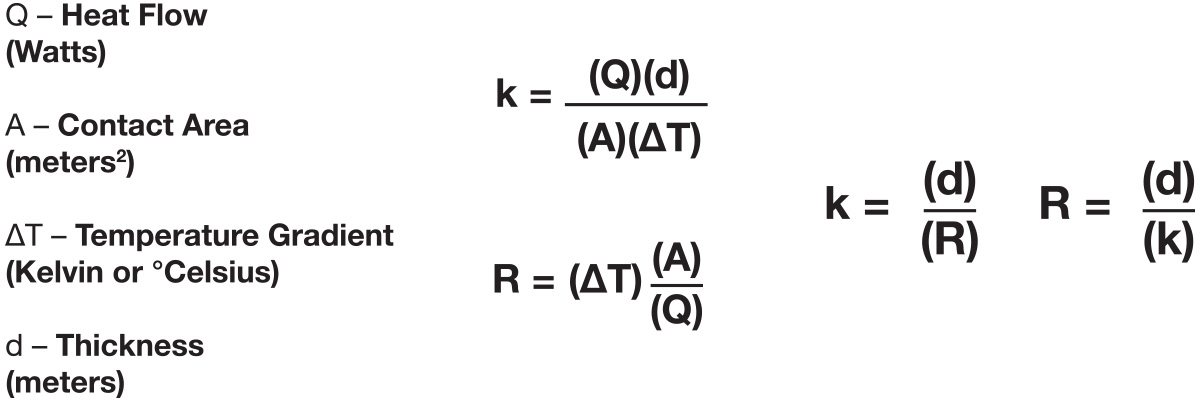
Dependent on thickness, because R is dependent on thickness.
Relationship between k and R
HeatSORB™
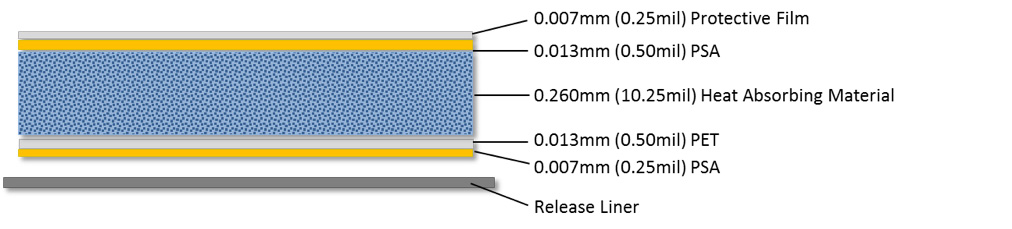
Rogers Corporation has introduced a new unique Phase Change Material (PCM)-a specialized category of thermal management products-called HeatSORB™. It is a proprietary PCM composite that captures and stores thermal energy, allowing a device or system to remain cooler for a longer period of time. Like a reservoir, it starts absorbing energy at its Phase Change Temperature of 43 degrees Celsius, until reaching capacity.
Total thickness of 0.3 mm composed of different supportive and protective layers as well as acrylic PSA.
HeatSORB™ is not meant as a direct replacement for solutions like heat pipes, spreaders or TIMs; rather, it’s another tool for engineers to add to their toolbox. It offers a different approach by creating a thermal buffer to delay temperature ramping, and protecting users or sensitive electronics from excess heat.
Zatkoff Seals & Packings offers HeatSORB™ and other Rogers thermal management products. Our Gasket Division is able to die-cut the material in custom shapes as well. To learn more or check our inventory, contact your local Zatkoff representative.